
“…do not be grieved, for the joy of the Lord is your strength.” Nehemiah 8:10
I’ve read this passage and heard it in song many times, but it’s never deeply resonated with me because I’ve never really understood it.
On the surface it sounds great. God’s joy seems like an obviously good thing. And strength is something I increasingly covet as age brings more responsibility and less vitality.
There’s a weariness in the mid-thirties fire of raising young kids that makes me long for the physical vigor, mental edge, and naive confidence I carried as a young man. Paul Simon’s metaphor strikes a chord, “Why am I soft in the middle, now? Why am I soft in the middle when the rest of my life is so hard?”
Life is richer than it’s ever been, but it constantly demands more of me than I have to give. I long for more strength.
Strength and Joy
The desire to be strong is good. The Bible is full of calls to be strong. But if we take these directives at face value, we miss the point entirely. When God commands Moses and Joshua to be strong, He is not asking them to dig deep and find strength within themselves.
He’s calling them to a counterintuitive strength, and he immediately gives them a basis for it. Be strong, He commands, not because you are great, mighty, or able, but because I will be with you wherever you go, and I AM great, mighty, and able. But where does Joy fit in?
When I think strength, I think brute strength, physical force, dogged willpower. But Joy? It’s not what comes to mind. If we are to find strength in God, wouldn’t that have more to do with his power than his joy? It’s never made much sense to me. But on a recent trip to Puerto Rico, it started to click because Nehemiah’s words moved from theoretical to experiential knowledge.
After a few days of hard work in the hot sun, I should’ve been whooped. But I wasn’t. I had gas in the tank and a smile on my face. I felt strong, when I should’ve been weak, and I believe it’s because of the Joy of Lord.
Hurricanes, Homes, and Hope
Let’s start with why I was in Puerto Rico in the first place. It wasn’t to sunbathe and sip piña coladas.
Puerto Rico is one of the most densely populated and hurricane vulnerable islands in the world. Since 1980, violent storms have caused eight different billion-dollar plus disaster events. 2017’s Hurricane Maria alone caused 115B worth of damage, devastating the island and taking nearly 3,000 lives. Relief always spikes after dramatic events, but the need for investment endures long after the Red Cross leaves.
Hunger Corp is a Puerto Rican ministry that’s dedicated to the enduring work. They’re in the trenches rebuilding homes and restoring dignity for vulnerable people across the island. My church has partnered with Hunger Corp for nearly a decade, providing financial support and sending a few small teams down each year to work on home construction projects. Last April, a friend reached out and asked me to join him on one of these trips.
Before I knew it, I was on a Boeing 757 with 17 other folks headed to San Juan. We arrived at SJU, hopped in a van, and drove 20 miles west to a little town called Dorado. A town that, like much of Puerto rico, is home to two separate socioeconomic realities.
Downtown Dorado is small working class community a mile inland from Puerto Rico’s northern coast. It’s a vibrant place, but its economy and infrastructure are fragile. Local businesses struggle to survive, and there’s no investment to drive meaningful growth.
Just a mile Northeast of the city center on the coast, though, are a handful of resorts and exclusive communities, including Ritz Carlton’s elite Reserve. The resorts pull global wealth into Dorado, but it doesn’t circulate outside of their gates.
But Hunger Corp is investing in Dorado. They’re restoring homes, supporting businesses, and fighting to improve the live’s of its residents. We worked on a house for an 82 year old man with dementia named Francisco. Francisco currently lives with his daughter, Magaly, in a house right next door to his on the same small piece of property.
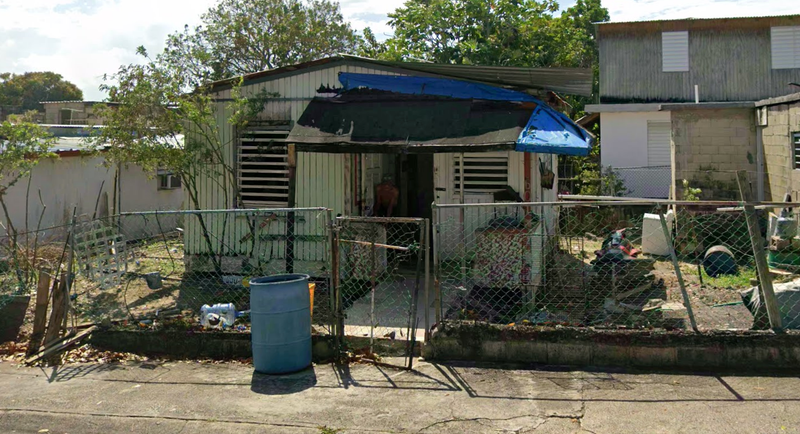
His old home was a wood frame, tin-roof (extremely vulnerable to hurricanes) structure that was barely holding together. Hunger Corp isn’t just replacing it, they’re giving him something better. Francisco’s new house will be a stronger, safer reinforced concrete block home.
Concrete is Heavy, and Puerto Rico is Hot
We spent four days working on Francisco’s house. The temperature hit nearly 90 each day with a heavy dose of humidity. I sweat through my clothes by about 10 AM everyday, and the work was backbreaking.
I spent Monday lifting 25lb buckets full of concrete to pour support columns for the house. Tuesday we moved 500 cinderblocks across the job site by hand. All week long we worked with concrete, mixing every bag manually with shovels and elbow grease, and hand mixing concrete is no joke. It’s basically a Metcon workout. The clock starts ticking as soon as you add water, so you have to move fast, and turning over gravel and sand with a shovel engages muscles you didn’t even know you had.
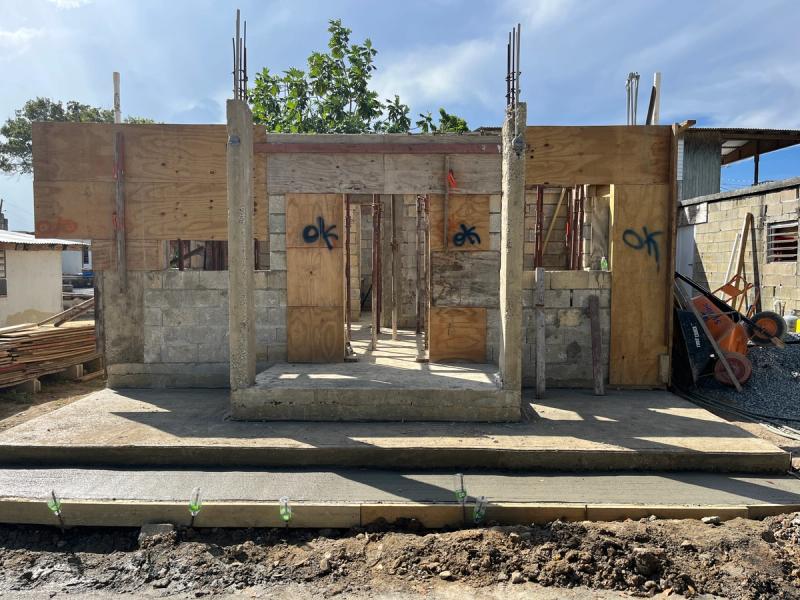
I’m a pretty active dude, but I work at a desk everyday, and four days of demanding physical labor was a shock to the system.
By day three I was feeling it. I should have been exhausted, but I had an inexplicable surge of energy. That’s when Nehemiah 8:10 came to mind. “…do not be grieved, for the joy of the Lord is your strength.”
I was working on a house in Puerto Rico with a group of folks who barely knew each other. We came together — in spite of being all over the map in terms of age, interests, personalities, and skillsets — to do hard work.
But no one was focused on how hard the work was. Everyone chipped in and encouraged each other. We sang songs to keep spirits high (by the last day were singing Feliz Navidad in the middle of October). We were serving others in the name of Jesus, and I believe that brought Joy to the Lord. And in his Joy I found strength, levity, and energy for the task at hand.
When You are Weak, Then You are Strong
Nehemiah delivered this word of encouragement to the Israelites outside the water gate in Jerusalem nearly 2,500 years ago in a wildly different context than my situation on Puerto Rico. But here’s why I think his words can faithfully be applied more broadly.
It’s about weakness. In Nehemiah 8, the Israelites were grieving their failure to uphold the covenant God established with them through Moses on Mount Sinai a thousand years earlier. They were weeping, recognizing they were weak, limited, and unable to keep God’s law. At the job site in Dorado, I was sore, tired, and fatigued. I was coming up against my physical limits, and I could sense my own weakness.
We all reckon with weakness. We come up against the limits of our abilities — spiritual, intellectual, physical, relational. We can see what we want to achieve, but we can’t make it happen. We may strive to ignore weakness, or actively refute it, but at the end of the day we know we are weak. limited. finite.
And that’s the point.
Because strength doesn’t come from within — in fact when we white knuckle and try to make things happen by our own strength, real strength moves out of reach. In God’s reverse economy, we find life when we lose it, we are more blessed when we give than receive, and we find strength when we embrace weakness.
So, when we’re weary, afraid, alone, or out of our depth, we look up to a God who cares. Who delights in us when we humble ourselves and come to him. Our dependance brings him Joy, and in His Joy we are strong. Because He is delighted and faithful to give us strength. He is the king, and in the light of His face (his joy), there is life.